MVP Development

MVP Development Services That Ship in 6-12 Weeks

We turn your idea into a working product that real users can pay for. Fixed scope, fixed price, and a written estimate before you commit a dollar.

Illustration of an MVP development team taking a product from idea to launch
Experts
15+
Years of shipping
5
Typical MVP delivery
6-12 wks
Post-launch support
30 days
Why an MVP

Build the Version Your Market Will Actually Pay For

The most expensive mistake in early-stage engineering is building the wrong product well. Founders routinely spend eleven months and most of their runway before the market delivers its verdict. An MVP compresses that verdict into weeks. It puts the smallest sellable version of your idea in front of live users and tells you whether to double down or change direction while you can still afford either answer.

InnovariaTech provides MVP development services for founders who need that verdict fast. We ship a working application that handles live users, payments, and production data from day one, then we help you read what those users do next. The build-measure-learn loop only works when the thing you built can actually be measured.

Our minimum viable product development services cover the full path: market and competitor research, feature prioritisation, UI/UX design, engineering, QA, deployment, and the first round of post-launch iteration. One team owns all of it. You never coordinate between a design agency, a backend contractor, and a QA freelancer who have never spoken to each other.


innovaria · mvp build log

  1. week 01scope lockedPRD approved, price fixed in writing
  2. week 03flows signed offclickable prototype, changes still free
  3. week 04sprint 1 shippedstaging build you can test yourself
  4. week 06feedback mergedflagged Friday, fixed the same sprint
  5. week 09QA passeddevices, browsers, edge cases
  6. week 11deployedproduction live, first traffic monitored
  7. week 12measuringactivation and retention flowing in
  8. nextyou decidedouble down, or change direction
Definition

What Is MVP Development?

MVP development means building the leanest working version of your product that still delivers your core value to a paying user. You strip the roadmap down to the one or two features that prove the idea, ship those to production, and let user behaviour direct everything you build afterwards.

Founders often confuse three different artefacts. Getting the distinction right saves months, so here is how they differ.

Illustration of Customer thinking what is a Mvp development
Proof of concept, prototype, and MVP compared across what each proves, who sees it, whether it is functional, whether it can earn revenue, and typical duration.
AttributeProof of ConceptPrototypeMVP
What it provesThe technology worksThe experience makes senseThe market will pay
Who sees itYour engineering teamStakeholders and investorsReal end users
Is it functional?Partly, in isolationNo, clickable mockup onlyYes, production-ready
Can it earn revenue?NoNoYes
Typical duration1 to 2 weeks1 to 3 weeks6 to 12 weeks

A proof of concept answers "can we build it?" A prototype answers "does it feel right?" An MVP answers the only question that keeps you solvent: "will anyone pay for it?"

What we build

Our MVP Development Services

We package MVP work into six services. Most founders take the end-to-end engagement, but you can start anywhere in the sequence.

MVP Consulting and Product Discovery

We research your market, map your competitors, and interrogate your assumptions before anyone writes code. You leave discovery with a prioritised feature list, a technical approach, a fixed timeline, and a written cost. If we think your idea needs a smaller scope than you planned, we say so during discovery, while changing course still costs nothing.

MVP Software Development

Our engineers build your MVP software on stacks we run in production every day: Node.js, Python, Laravel, and PHP on the backend; React, Next.js, and Vue on the frontend; PostgreSQL, MySQL, and MongoDB for data. We choose the stack your product needs, not the framework trending on Hacker News this month. See our full custom software development capability.

MVP App Development

We build iOS and Android MVPs with Flutter and React Native, so one codebase covers both platforms and your budget covers twice the ground. Cross-platform app development is the default choice here. Our team handles UX, the build, app store submission, and the review process. You do not manage three contractors to ship one app.

SaaS MVP Development

We architect multi-tenant SaaS MVPs with subscription billing, role-based access, and usage analytics built in from the first sprint. We design the data model so your tenth customer does not force a rewrite.

AI MVP Development

We integrate LLMs, build AI agents, and ship generative AI solutions using the OpenAI API, LangChain, TensorFlow, and Hugging Face. We also tell you when your product does not need AI, which saves more founders more money than any feature we build.

Blockchain and Web3 MVP Development

We deploy smart contracts across 20+ networks including Ethereum, Solana, Polygon, and BNB Chain. Every contract passes our five-stage internal security review, covering Slither and Mythril analysis, a manual line-by-line audit, a severity-ranked report, and a verification re-audit, before it touches mainnet. No client contract we have deployed has been exploited post-launch. Explore our full blockchain development practice.

Not sure which of these you need? Tell us where your product is today and we will scope the right engagement.

Technology

The Stack We Build MVPs On

We pick tools we run in production, keep dependencies minimal, and write code a developer who did not build it can still maintain. That is what keeps your long-term costs down.

Frontend
ReactNext.jsVue.jsTypeScriptTailwind CSS
Backend
Node.jsPythonPHPLaravelRESTGraphQL
Mobile
FlutterReact NativeSwiftKotlin
Databases
PostgreSQLMySQLMongoDBRedis
Blockchain
SolidityEthereumPolygonSolanaHardhatEthers.js
AI and ML
OpenAI APILangChainTensorFlowHugging Face
Design
FigmaAdobe XD
Our process

Our MVP Development Process

Five stages. You know what happens in each one, what you receive, and how long it takes before we start.

1. Discovery and Validation

We interview you, study your competitors, and define your target user. Then we run your feature list through a prioritisation framework, MoSCoW or RICE depending on how many features you arrived with, and cut it to the set that proves your hypothesis. You approve the scope in writing before we continue.

Week 1

You receive

  • Product requirements document
  • Prioritised feature list
  • Technical architecture outline
  • A fixed price

2. UX and UI Design

We map every user journey, then build wireframes and a clickable Figma prototype. You click through the real flows and change whatever you want at this stage. Moving a screen around in Figma takes minutes. Moving it after the backend is wired to it takes a sprint, so we get the flows right here.

Weeks 2 to 3

You receive

  • User flow diagrams
  • Wireframes
  • Clickable prototype
  • Design system

3. Engineering

We build in weekly sprints and push every build to a staging environment you can access. You test the real product every Friday and flag issues while the context is fresh, and we fix them inside the same sprint. Nothing waits three weeks for a review meeting.

Weeks 3 to 9

You receive

  • Weekly staging builds
  • Sprint demos
  • Written progress report

4. QA and Launch

We run manual and automated tests across devices, browsers, and edge cases. Smart contracts go through our five-stage internal security review. We configure production infrastructure, deploy, and monitor the first live traffic with you watching the same dashboard.

Weeks 9 to 11

You receive

  • Test report
  • Production deployment
  • Deployment runbook
  • The repository

5. Measure and Iterate

We instrument your MVP so you see activation, retention, and drop-off from day one. We review the data with you, identify what users actually do rather than what they say, and plan the next build cycle around evidence. Every engagement includes 30 days of post-launch support.

Week 12 onward

You receive

  • Analytics dashboard
  • Post-launch performance review
  • Prioritised iteration roadmap
Timeline

How Long Does MVP Development Take?

Most MVPs we deliver land between 6 and 12 weeks. Scope drives the number, and here is what different scopes actually take.

MVP types with their delivery timeline in weeks and what each scope includes.
MVP typeTimelineWhat it includes
Landing page / validation MVP1 to 2 weeksA conversion-focused page, waitlist capture, and analytics to measure demand before you build
Single-feature MVP4 to 6 weeksOne core feature built properly, with authentication and a basic dashboard
Mobile app MVP8 to 12 weeksCross-platform iOS and Android build, backend, and app store submission
SaaS MVPExtended10 to 14 weeksMulti-tenant architecture, subscription billing, roles and permissions, admin panel
AI-enabled MVPExtended10 to 14 weeksCore product plus LLM integration, prompt pipeline, and evaluation harness
Web3 / blockchain MVPExtended10 to 16 weeksSmart contracts, wallet integration, frontend, and a full security audit

Standard builds fit the 6 to 12 week window we promise up front. Extended-scope builds, meaning multi-tenant SaaS, AI pipelines, and audited blockchain systems, carry more moving parts and can run to 16 weeks. We tell you which category your product falls into during discovery, and we commit to the specific timeline in writing before the project starts. If we miss a milestone, you hear about it in that week's report.

Industries

Who We Build MVPs For

We work across eight industries, and regulated sectors are where generic agencies get expensive. Compliance is not a feature you bolt on after launch. It shapes your schema, your access model, and your hosting decisions from day one. We scope those constraints before writing code, not during your compliance review.

Track record

Products We Have Shipped

Real MVPs, running in production. Here is what each one does and what went into it.

Veyrais

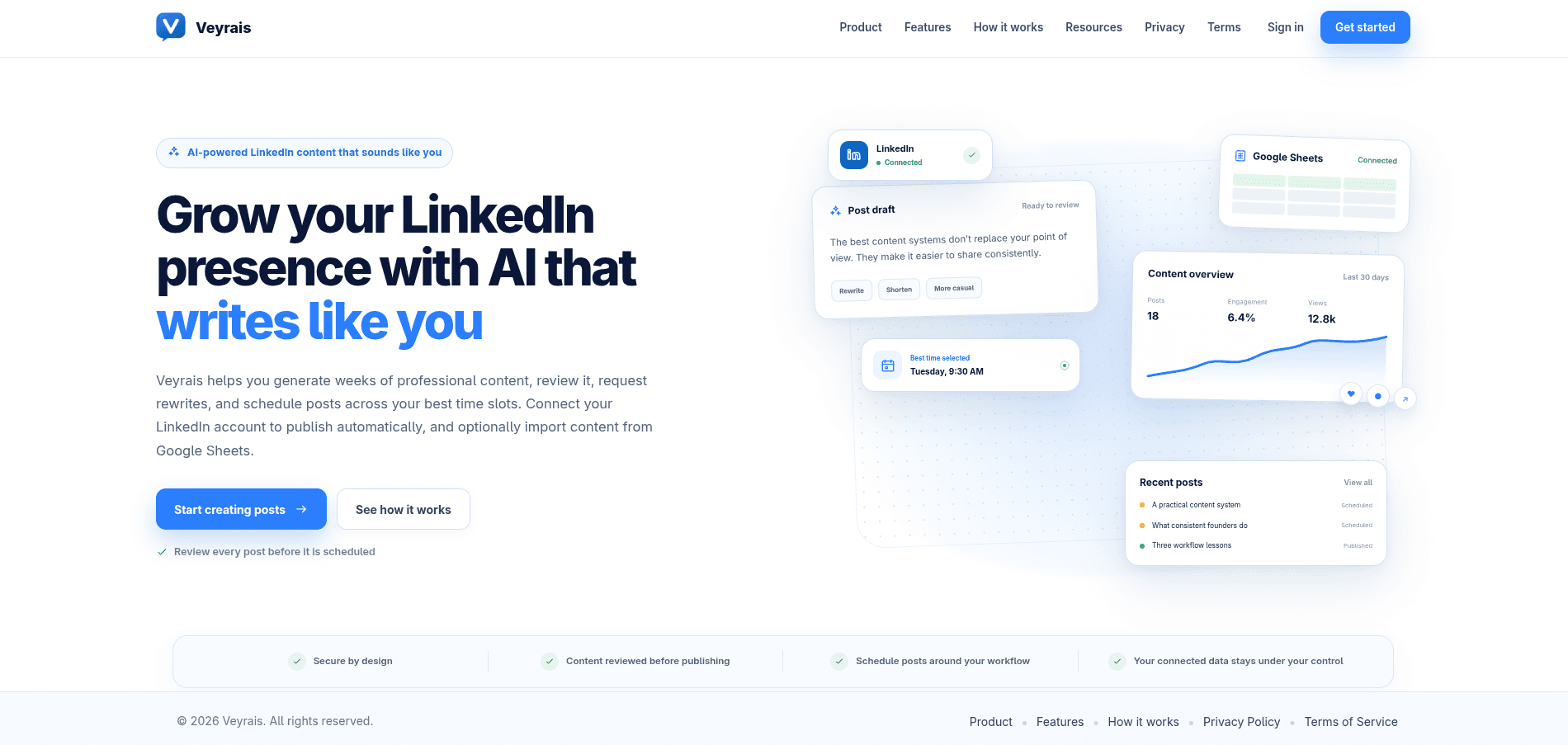
Veyrais AI LinkedIn content platform landing page showing post drafting, scheduling and content analytics
AI · SaaS

Veyrais

An AI writing platform that produces weeks of LinkedIn content in the user's own voice. Every post is reviewed and editable before anything publishes, then scheduled into the time slots that perform best.

Business impact

Turns LinkedIn content from a per-post manual effort into a repeatable pipeline: topic research, drafting, scheduling, analytics and subscription billing all run in one system.

Veyrais has made LinkedIn content creation significantly easier. Instead of spending hours researching topics and writing every post from scratch, I can discover relevant ideas, generate drafts, and manage my entire content pipeline from one dashboard. It has helped me stay consistent without sacrificing content quality.
Regina M. NoriegaManaging Director, Timgen Media

Key features

  • Topic discovery tuned to the user's professional positioning
  • AI drafting in the user's own writing voice
  • Rewrite, shorten and tone controls on every draft
  • Visual content pipeline from idea through to published post
  • Direct LinkedIn connection for automatic publishing
  • Best-time scheduling across the week
  • Optional Google Sheets import for bulk content
  • Content analytics for posts, engagement rate and views
  • Subscription billing, plans and usage limits
  • Nothing publishes until the user approves it

Read what our clients say in their own words

Showing project 1 of 5: Veyrais

That is what our MVPs look like.

Describe yours and we will send back a line-itemised estimate, with a fixed price and a delivery date, before you commit to anything.

Pricing

MVP Development Cost

Agencies hide pricing to force a sales call. We publish ours, because a founder who cannot afford us deserves to find that out in ten seconds, before anyone schedules a meeting.

Every engagement type we run, and what each one costs, is below.

MVP engagement types with typical cost ranges in US dollars and the situation each one suits.
EngagementTypical costBest suited to
Prove the idea
Validation MVP$2,000 to $3,000Testing demand before committing to a full build
Single-feature MVPMost common$4,000 to $6,000Proving one core hypothesis with a working product
Build the product
Standard MVP$15,000 to $20,000Most funded and bootstrapped startups launching a real product
Specialist builds
Web3 / blockchain MVP$18,000 to $25,000Smart contract systems requiring a full security audit
Why blockchain sits higher
A blockchain build carries the most scope: contract design, on-chain testing, and a full security review before anything reaches mainnet. That is why it sits above a standard product build. We tell you which category your product falls into before you commit to anything.
What moves the number
How many features you keep after prioritisation, how many third-party systems you integrate, whether you need custom design or a well-executed component library, and which compliance regimes apply. HIPAA, GDPR, PCI DSS, and KYC/AML all add scope.
Before you commit
You receive a line-itemised written estimate before you commit to anything. Nothing gets added to an invoice that was not in that document.
Differentiators

Why Founders Choose InnovariaTech as Their MVP Development Company

They went above and beyond in shaping my concept for the Movie Mint NFT marketplace into a well-architected, fully implemented product. Every decision was explained, every deadline met. I would not hesitate to work with them again.
Calvin NoelCEO, Movie Mint

Turn your idea into an MVP. Schedule a discovery call and get a dedicated team aligned within one week.

Risk

Risks We Remove From Your MVP Build

RiskUnclear requirements
How we remove itWe convert your idea into a written, approved specification during discovery, which cuts rework and stops features creeping in mid-sprint.
RiskBudget overruns
How we remove itWe fix the price before development starts and change scope only when you approve it in writing.
RiskMissed deadlines
How we remove itWe break delivery into weekly milestones with published check-ins, so any slippage surfaces early enough to correct.
RiskPoor product-market fit
How we remove itWe validate demand during discovery and instrument the MVP so real user behaviour drives what you build next.
RiskScalability walls
How we remove itWe design the architecture for the product you intend to grow, so early traction does not force a rewrite.
RiskSecurity exposure
How we remove itWe run automated and manual audits before launch, and every smart contract passes a five-stage review before mainnet deployment.
Questions

MVP Development FAQs

What is MVP development?

MVP development means building the smallest working version of your product that still delivers your core value to real users. You launch it, watch how people actually use it, and let that evidence guide what you build next. It replaces guesswork with data before you spend a full development budget.

How much do MVP development services cost?

Our MVPs range from $2,000 for a validation build to $25,000 for an audited blockchain build. A full standard MVP runs $15,000 to $20,000, and most founders proving a single core feature land between $4,000 and $6,000. You receive a line-itemised written estimate before you commit, and nothing appears on an invoice that was not in that document.

How long does it take to build an MVP?

Most MVPs ship in 6 to 12 weeks. A validation MVP takes 1 to 2 weeks, a single-feature build takes 4 to 6, a mobile app takes 8 to 12, and a SaaS or blockchain platform takes 10 to 16. We commit to your specific timeline in writing before the project starts.

What is the difference between an MVP and a prototype?

A prototype is a clickable mockup that shows how your product will look and feel, and nobody can buy it. An MVP is a working product that real users can sign up for and pay for. A prototype tests the experience; an MVP tests the market.

Do you build MVPs for early-stage startups?

Yes. We run fixed-budget engagements designed specifically for early-stage founders who need to validate an idea without burning their runway. We scope to what your budget genuinely buys and tell you upfront if your feature list exceeds it.

Who owns the code and IP for my MVP?

You do, completely. On handover you receive the repository, the deployment runbook, and the architecture documentation. There is no lock-in and no retainer required to access your own product.

Can you scale my MVP after launch?

Yes. We design the architecture with growth in mind, so scaling usually means adding capacity rather than rebuilding. Every engagement includes 30 days of post-launch support, and we can continue as your product team afterwards.

What technologies do you use for MVP development?

We build with React, Next.js, and Vue on the frontend; Node.js, Python, and Laravel on the backend; Flutter and React Native for mobile; and Solidity across 20+ blockchain networks. We select the stack your product needs rather than defaulting to one.

Do you sign an NDA before we discuss my idea?

Yes. We sign an NDA before any detailed discussion of your product. Your idea, your data, and your business model stay confidential.

What happens if my MVP does not find product-market fit?

Then the MVP has done its job: it told you cheaply, in weeks, what a full build would have told you after a year and a full budget. We review the analytics with you, identify which assumption broke, and help you decide whether to pivot the product, the audience, or the pricing before you invest further.

Tell Us What You Are Building

Fixed price. Written estimate. No commitment.

Describe your idea and we will tell you what it takes to build, how long it takes, and what it costs. In writing, before you commit to anything. The first conversation costs nothing, whether you launch next month or you are still testing the idea.

Adjacent engagements you may need alongside this one.